> For the complete documentation index, see [llms.txt](https://docs.ts.finance/llms.txt). Markdown versions of documentation pages are available by appending `.md` to page URLs; this page is available as [Markdown](https://docs.ts.finance/protocol-mechanisms/alpha-market/new-feature-exercise-delivery.md).
# New Feature: Exercise - Delivery
TermMax Alpha has upgraded its take profit options, giving users more flexibility and better execution.
## What's Changed
Previously, there was only one way to take profit. Now, you have two options:
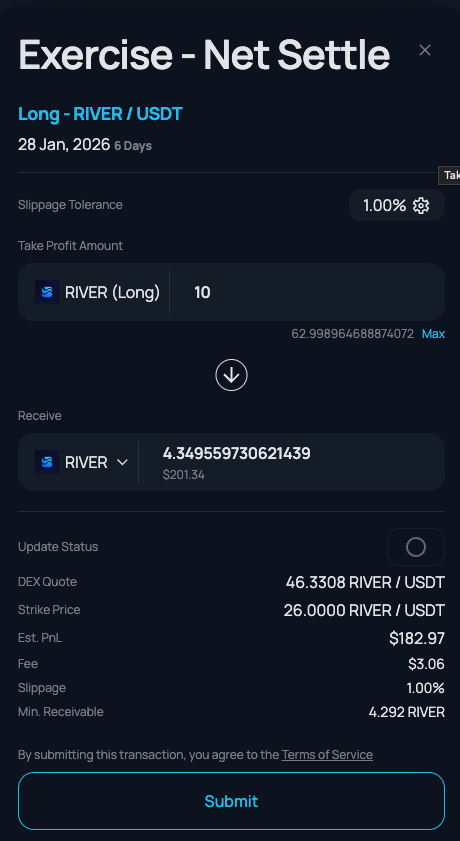
1. Exercise - Net Settle (previously "Take Profit")
2. Exercise - Delivery (new feature)
### 1. Exercise - Net Settle (Cash/Token Settlement)
* Profit is automatically calculated, and you can claim it in your preferred asset (USDT or the underlying token)
* **Partial or Full Settlement**:
* Partial settlement: only a portion of your position is settled, remaining position stays open
* Full settlement: entire position is settled, no remaining exposure
* Quick and easy to execute
* Most effective when on-chain liquidity is sufficient
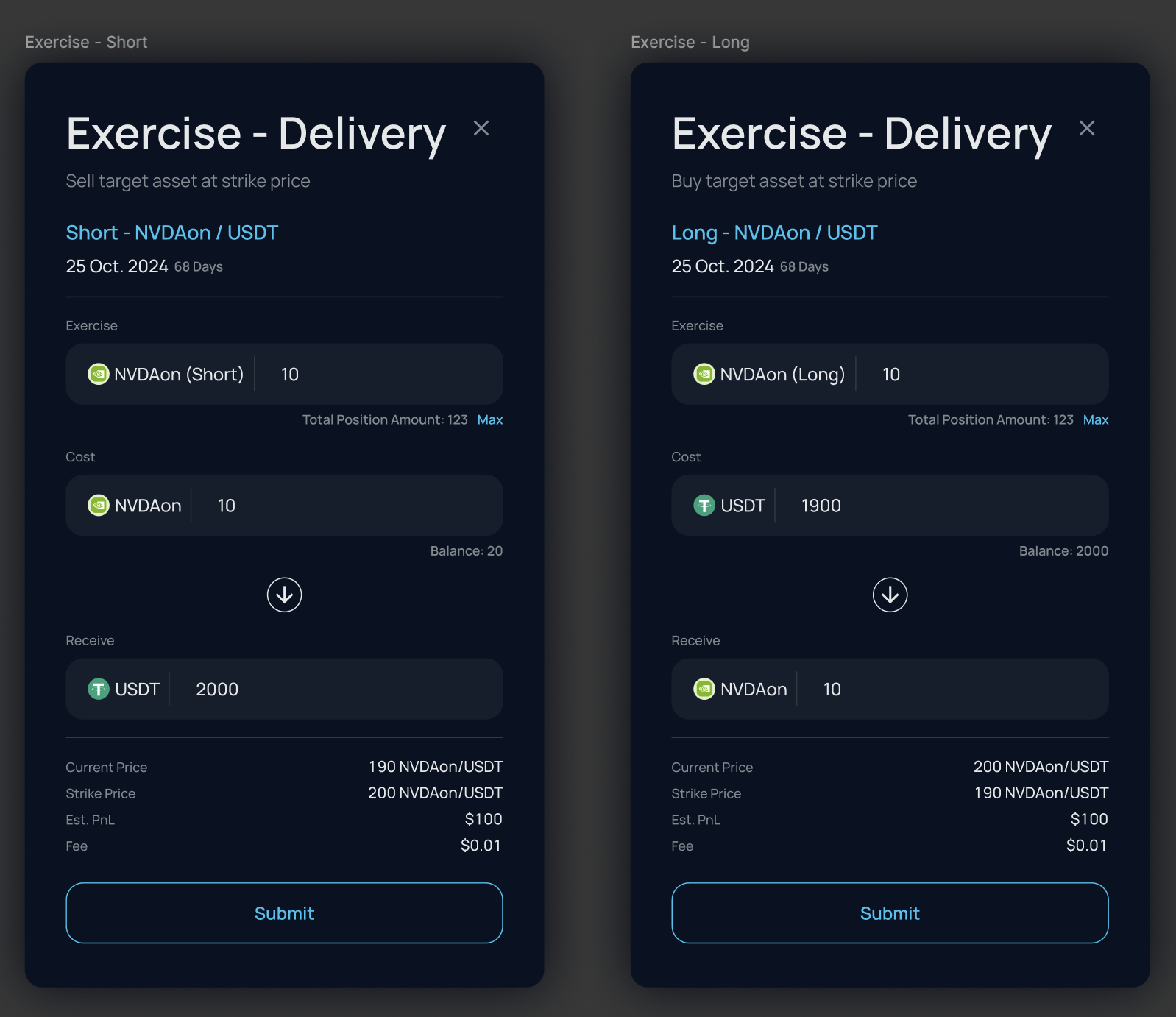
### 2. Exercise - Delivery (Physical Delivery)
When DEX liquidity is insufficient, using Net Settle may incur slippage or be exposed to MEV attacks, especially for large positions. Profits in such cases may be lower than Delivery. Users can choose Delivery in this scenario.
* **Long Position (Long):** Users buy the underlying asset at the strike price using USDT.
* Users can sell the underlying asset at a better price in markets with higher liquidity (e.g., centralized exchanges)
* Profit = Proceeds from selling the underlying asset in other markets − USDT paid at the strike price
* **Short Position (Short):** Users sell the underlying asset at the strike price.
* Users can buy the underlying asset at a better price in markets with higher liquidity (e.g., centralized exchanges)
* Profit = Proceeds from selling the underlying asset at the strike price − Cost of buying the underlying asset in other markets
* **Partial or Full Delivery**
* Partial Delivery: Exercise and deliver only a portion of the position, keeping the remaining position open.
* Full Delivery: Exercise and deliver the entire position, closing the position.
### 3. Summary
When DEX liquidity is insufficient, using Net Settle may result in slippage or be exposed to MEV attacks, especially for large positions. In such cases, profits may be lower than Delivery, and you can choose Delivery instead.
When on-chain liquidity is sufficient, the outcomes of Net Settle and Delivery are usually similar. In this case, users can freely choose based on personal preference, convenience, or strategy.
**Note:**\
After execution (via Net Settle or Delivery), users will receive their realized profit upfront, along with a GT position. This position does not impact your earnings and requires no action. While it can be ignored, users may optionally manage it to capture additional yield opportunities, depending on market conditions.
---
# Agent Instructions
This documentation is published with GitBook. GitBook is the documentation platform designed so that both humans and AI agents can read, navigate, and reason over technical content effectively. Learn more at gitbook.com.
## Querying This Documentation
If you need additional information that is not directly available in this page, you can query the documentation by asking a question.
Perform an HTTP GET request on the following URL with the `ask` and `goal` query parameters:
```
GET https://docs.ts.finance/protocol-mechanisms/alpha-market/new-feature-exercise-delivery.md?ask=&goal=
```
`ask` is the immediate question: it should be specific, self-contained, and written in natural language.
`goal` is what the user is ultimately trying to achieve, the reason they need the answer. Sharing it helps GitBook give you a better, more relevant answer. A goal is most helpful when it describes the outcome the user wants rather than restating the question. For example, with `ask=how do I create an API token`, a goal like `automate deployments from our CI pipeline` lets GitBook tailor the answer to that use case.
The response will contain a direct answer to the question and relevant excerpts and sources from the documentation.
Use this mechanism when the answer is not explicitly present in the current page, you need clarification or additional context, or you want to retrieve related documentation sections.